Understanding the Tides of Singapore’s Property Market
Singapore’s property market combines economic strength with disciplined regulation. Its history — captured in the undulations of the Private Property Price Index — shows how strategic policy interventions and market responses interact over decades.
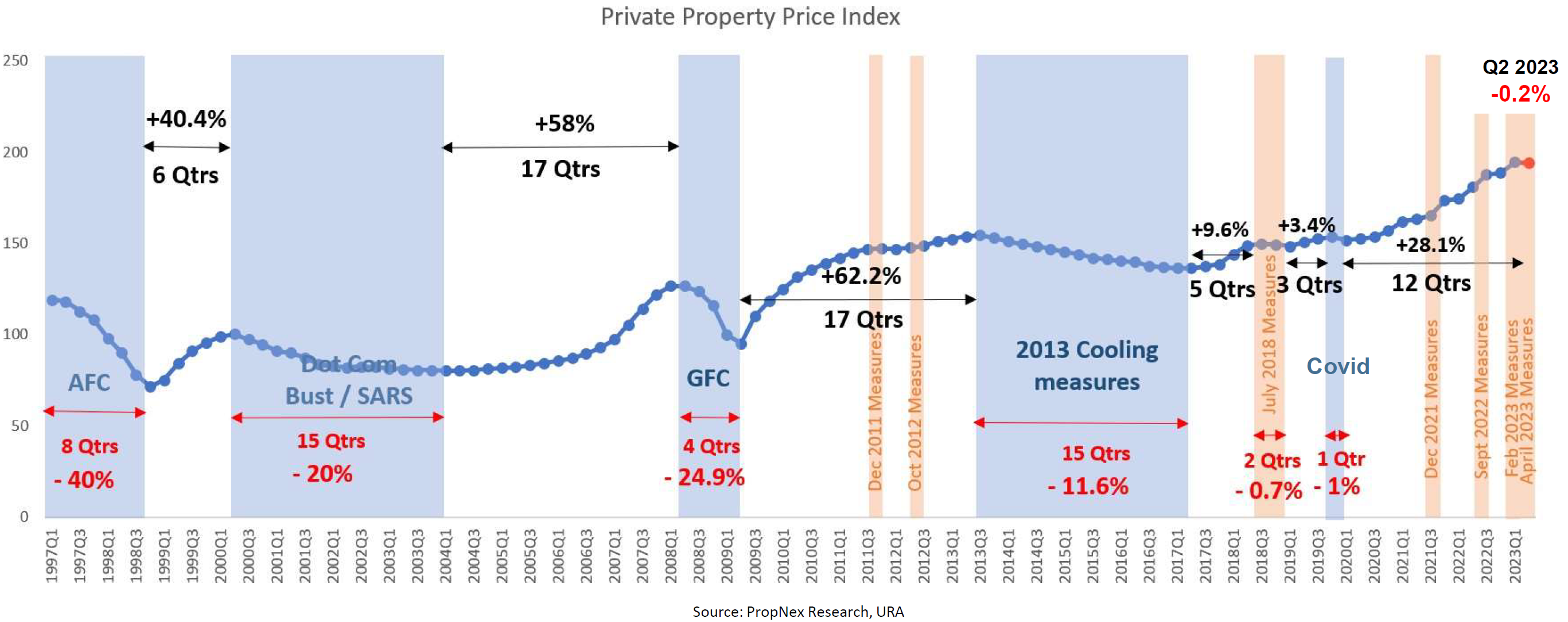
This article walks major episodes (Asian Financial Crisis, SARS, Global Financial Crisis, cooling-measure era, COVID) and offers a framework for buyers and investors. Figures and episode descriptions follow the original Nov 2023 essay — update any live decision with current URA / MAS data.
From turbulence to triumph: a market’s journey through crises
The resilience of Singapore’s property market has been tested repeatedly.
- Asian Financial Crisis (AFC) — a severe multi-quarter contraction (on the order of ~40% in the historical narrative), then recovery as macro conditions stabilised.
- SARS outbreak — another sharp drawdown (~20% over subsequent quarters in the original framing), followed by a strong multi-year climb (the original essay cited ~58% over 17 quarters post-SARS).
These episodes were not “prices only go up.” They show deep stress is possible, and that recovery has often followed when economic fundamentals, policy response, and banking system liquidity held.
The Global Financial Crisis: agility and adaptability
The 2008 Global Financial Crisis was another stress test. In the original narrative, private prices fell sharply (~24.9% in four quarters) before a strong multi-quarter rebound (~62.2% over 17 quarters). The takeaway is adaptability under a relatively robust regulatory and banking framework — not a promise that every future shock will resolve the same way.
Cooling measures: steering toward stability
Since their expansion, government cooling measures have been central to market shape:
- Additional Buyer’s Stamp Duty (ABSD)
- Seller’s Stamp Duty (SSD)
- More conservative loan-to-value (LTV) ratios
- Total Debt Servicing Ratio (TDSR)
These tools curb speculative churn and force more financial prudence. The practical result, relative to earlier boom-bust amplitudes, has been a market with less violent drawdowns — at the cost of higher friction for multi-property and foreign demand.
In the original essay’s reading, since public adaptation to these measures, the market saw a more stable rise from about 2017, with only a minor ~1% dip during peak COVID uncertainty — very different from 20–40% class historical crashes.
The COVID interlude
Globally, COVID was a severe shock. Locally, the private residential market’s imprint was milder in the original account: a shallow dip, then multi-quarter gains (the essay cited ~28.1% over 12 quarters after the trough). Fiscal and monetary support formed part of the buffer. Treat that path as history, not a template for the next shock.
Decoding current trends (as of the original Q2 2023 note)
A small quarterly correction (the essay referenced ~0.2%) can mean several things at once:
- Digestion of prior cooling rounds
- Higher interest rates or global risk-off
- Segment-specific noise (region, new launch vs resale)
- Anticipation of policy or geopolitical stress
A single print is rarely a full thesis. Pair index moves with transaction volume, inventory, mortgage rates, and the policy calendar.
Will Singapore property prices fall?
Forecasting is hard. Historical insight supports a cautious stance: periodic adjustments are normal; long-run private residential path has often drifted upward when the economy and policy stance held; cooling measures have aimed to prevent the most extreme speculative blow-offs.
That does not make every project or unit “safe.” Micro location, lease, product, and entry price dominate individual outcomes.
Economic indicators and market fundamentals
Useful macro companions to the price index:
- GDP growth and employment
- Interest-rate path and mortgage packages
- Foreign and local demand under ABSD tiers
- Pipeline supply by region
- Demographics and household formation
Singapore residential real estate is tightly coupled to national economic health and policy stance.
Investor and homebuyer guide
- Navigate with constraints first (cash, tenure, ABSD tier, use case) — not timing heroics alone.
- Treat cooling measures as guardrails that protect long-term discipline.
- Use dips to re-check fundamentals, not as forced FOMO or forced freeze.
- For portfolio moves, map exit options (liquidity, SSD if any, lease) before entry.
The path ahead
Singapore’s private market has shown resilience through crises and a more managed cycle under cooling measures. Confidence should still be earned project by project, with patience and scenario discipline.
See also
- ABSD guide — how tax tiers reshape demand
- LTV & tenure — leverage rules under cooling measures
- 6 methods to analyze a property — project selection after you decide to act
Embarking with clear structure
Whether you are buying a first home, upgrading, or adding a second property, the useful question is rarely “will the index rise next quarter?” It is: given my constraints and the current policy set, which paths are viable?
WhatsApp with the decision you are weighing — we structure scenarios against policy and cash, analysis before capital.